

Box Cushion Instructions
Box Cushion Instructions

A box or welted cushion is used mainly for seating on chairs or window seats where more depth is required. To achieve this, side sections or welts are added between the top and bottom cushion pieces.
They can be made in a range of fabrics to match, contrast or co-ordinate with your existing soft furnishings.
The instructions below are for a square box cushion with piping cord around the top edge only.
However, these instructions can be followed for other shapes of box cushions once the fabric has been cut to the desired size and shape, allowing 0.5″ (12 mm) on all edges for seam allowances.

Requirements:
Deep cushion pad or piece of foam in the desired shape and size.
Suitable fabric.
Matching thread.
Piping, long enough for the perimeter of the top cushion piece.
Zip, 2″ (5 cms) shorter than the length of the back of the cushion pad or foam.
Measuring the Cushion Pad or Foam:
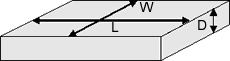
• Measure the width (W) and the length (L) of the cushion pad or foam.
• Measure the depth (D) of the cushion pad or foam.
Making a Box Cushion:
• To prepare the welt, cut 2 pieces of fabric each measuring, the length of the cushion (L) by the required depth (D), adding 0.5″ (12 mm) to all edges for seams. Cut 2 pieces of fabric each measuring, the width of the cushion (W) by the required depth (D), adding 0.5″ (12 mm) to all edges for seams. Make sure to cut the depth (D) from down the length of the fabric.
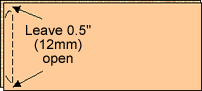
• Join the welt pieces together to form a ring, making sure that any design or nap on the fabric is the right way up on all the pieces. Pin the ends of the strips, right sides together, and stitch, 0.5” (12 mm) in from the raw edges, using a flat seam, leaving 0.5″ (12 mm) free at each end of each seam. Press the seams open.
• Cut the top and bottom cushion pieces to the required size, adding 0.5″ (12 mm) to all sides for the seam allowances. If patterned fabric is used, make sure to centre any design on the fabric.
• Place the bottom edge of the welt around the outer edge of the bottom cushion piece, right sides together and matching the raw edges. Align the seams on the welt to the corners of the cushion piece so that the seam allowance on the welt opens at the corners. Pin in place, 0.5” (12 mm) in from the raw edges.
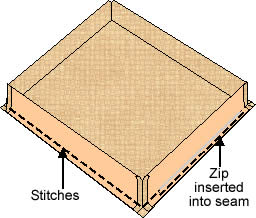
• Insert a lapped zip into the seam at the back of the cushion, positioning the teeth of the zip on the side of the welt. Leave the zip open.
• Stitch the other 3 sides of the welt to the bottom cushion piece, matching the seams on the welt to the corners of the bottom piece.
• Attach the piping cord to the perimeter of the top cushion piece. Starting and finishing at the back of the cushion and joining the ends of the piping cord to neaten.
• Pin the top section to the top edge of the welt, 0.5” (12 mm) in from the raw edges and matching the corners. Stitch in place using a zipper foot on the sewing machine so that the stitches are close to the piping cord. Turn right side out through the open zip.
• Insert the cushion pad or foam into the cover and close the zip.


Wow great!!! this is the neatest tutorial ever. Thank you so much for sharing!
with this easy method, you make it so easy!! Thank you so much.